Showing posts with label Deprivation of Liberty Safeguards. Show all posts

Tuesday, 30 September 2014

Better deprivation of liberties safeguards for older people after Supreme Court decision is implemented

https://www.youtube.com/watch?v=Nq1G9C7hKWk&list=UUdkf93h71xVAl28v467Hk7wI didn't cover the Supreme Court 'Deprivation of Liberties safeguards' decision in the 'Cheshire West' case six months ago or so on this blog, but on my more professionally oriented 'Social Work and End-of-Life Care' blog, which you can look at for more details.

Link to deprivation of Liberties safeguards posts on 'Social Work and End-of-Life Care' bog.

Link to the Supreme Court decision.

But there's a fairly recent professional commentary on the Community Care website for social work professionals which demonstrates the aftermath, that local councils have been inundated with applications for Dols authorisations. This means that older people (and others, but older people are a substantial group affected) are having their rights better protected.The writer makes the point that the decision enshrines social work values in the law.

Link to Community Care article

There are now quite a lot of commentaries on the effects of the decision. A particularly good one is on the mental health law online website, which also has loads of links to previous relevant legal decisions and to good explanations of the law, including a video of Lady Hale, the supreme court judge, explaining it in Court.

Link to Mental Health Law online. 

The MHLO summary of the effect of the decision is also helpful, as follows:
 (1) The 'acid test' for deprivation of liberty is whether the person is under continuous supervision and control and is not free to leave. (2) The following are not relevant: (a) the person's compliance or lack of objection; (b) the relative normality of the placement (whatever the comparison made); and (c) the reason or purpose behind a particular placement. (3) Because of the extreme vulnerability of people like P, MIG and MEG, decision-makers should err on the side of caution in deciding what constitutes a deprivation of liberty.

Link to Lady Hale video.


Tuesday, 4 March 2014

Older people should have a stimulating life even if they need care

http://www.cqc.org.uk/public/publications/reports/deprivation-liberty-safeguards-2012/13
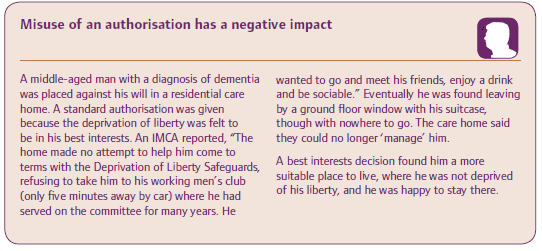
An interesting case study of the misuse of a Deprivation of Liberties Safeguards (DoLS) authorisation, which demonstrates the importance of good practice. Care homes and hospitals have to take out these authorisations if they're going to stop you doing things that normally you would be free to do, for example go out on your own if you're unsafe. My view is that it's not good enough just to comply with the safeguards; here you have a man who was legitimately deprived of his freedom, because he was at risk when he was living on his own with dementia. But once admitted to a care home, they did not work at trying to give him as much freedom within the constraints that were necessary, and so lumbered him with a more miserable life than they needed to do. I can't say often enough that just caring for older people won't do, you have to give them a worthwhile life. Even though someone has their freedom curtailed in some respects, it's still possible to give them freedoms in many other aspects of their lives. Social workers should be supporting care staff to do that, even if the managers of the care homes isn't good enough to manage it on their own.

This comes from the annual Care Quality Commission review of the operation of the Deprivation of Liberty Safeguards. The development of these safeguards has been going very slowly, and it is suspected that a lot of care homes and hospitals are breaking the law. It seems that, while there is some good practice, there are still a lot of people who do not know about the safeguards, and so cannot operate them correctly. Although there is confusion about what deprivation of liberty is, what the DoLS scheme does is force you to think it through. The CQC review provides a lot of interesting case studies and citations to recent legal cases, and comprehensive links to guidance.

Link to the CQC review.

Tuesday, 7 January 2014

Involve carers in older people's care for the best outcomes

Older people with dementia are often living with frail husbands or wives; sometimes both have dementia. A Local Government Commissioner's Report (done with the Health Service Commissioner) on a case in Kirklees (in West Yorkshire, it covers the towns of Dewsbury and Huddersfield and smaller towns in between) shows how difficult it may be to deal with such situations, but how supporting the family's involvement is crucial.

In 2009 the husband (with dementia) was admitted to hospital with acute glaucoma, probably caused by a blow from his wife, whose dementia was also showing up. There seems to have been a safeguarding investigation, but it was never followed up, and the husband was shot out of hospital with no protection. This is not a big surprise to anyone familiar with health and social care: hospitals dealing with in-hospital decisions, especially if they need a bed for someone else, often know nothing about and therefore take no account of the home situation in their decision-making. If they employed or even liaised with social workers, they might know more about what's going on in their patients' lives.

The wife's symptoms worsened, and she was admitted to hospital: her husband went into respite care. Their son, a doctor, fixed up a private care arrangement for a nurse to provide home care, but the health trust and the local authority decided this was inadequate (without consulting him) and issued a Deprivation of Liberties order to authorise themselves to keep the husband in respite care without his consent. The health trust also took it upon themselves to write to the son telling him he should put them in separate homes, and sent a copy of the letter, presumably following the usual transparency guidelines, to the mother, causing her great distress.

The Local Government Commissioner said:
...the couple were denied the chance of living at home together in a settled lifestyle for longer than they did. The couple suffered a needless loss of dignity, while their son felt ignored, undermined and excluded from any decision about their care.
and the Health Service Commissioner said:
Involving their son could have led to better outcomes for the couple. Families and carers can have the key to understanding the needs of their loved ones. That’s why public services must, in law, involve families and carers in making life changing decisions for vulnerable people.
Utterly reasonable, and in addition to apologies, reviews of their practice and financial compensation, the trust and the local authority also agreed to review how they implemented their complaints policies, so presumably they told the family to buzz off when they complained, too.

Link to the Local Government Commissioner's (Ombudsmen) Report.

Thursday, 12 September 2013

Are women and ethnic minorities getting protection against deprivation of their liberty in hospital and social care?

Older people should be interested in the Deprivation of Liberty Safeguards (DOLS), because most of the people affected by official decisions to deprive them of their liberty under the Mental Capacity Act 2005 are older people affected by dementia, as you can see from this chart, published in the annual report on DOLs by the Health and Social Care Information Centre.

What this bar chart also tells you is that the rates of application are the same for men and women (the rates are per 100,000 in the population), but I think they shouldn't be because most applications are about older people and most older people are women: are men getting a disproportionate amount of protection from being deprived of their liberty?

And if you look at ethnicity a lower rate of white people are  affected by applications than the total rate of all other ethnicities, when white people are massively predominant in the population. Are agencies more prepared to make applications for the depriving non-white people of their liberty?

The law on DOLS is a bit hazy and the procedures are confusing, so it's not surprising that DOLS applications are still not hitting the expected rates, even after several years of the Safeguards being in operation. Numbers of applications are going up every year, although the rate of increase has slowed. That suggests that there are probably quite a lot of people who are being deprived of their liberty (although restriction of liberty is OK, so long as it's not continuous and heavy - that's one of the confusing thing about the law), and who are not getting the protection of the assessments that the Safeguards require. You can get some clue to this, by looking at the reasons applications were not granted. By far the most common reason was that nobody had done an adequate best interests assessment, so health and social care agencies weren't really looking too carefully at the best interests of the people they are supposed to be caring for.

Most of the people affected will be in hospitals and care homes. The Safeguards require health and social care organisations, that are depriving people of their liberty as part of caring for them, to carry out an assessment of the decision (or lack of decision) to do this. Mostly this is hospitals and care homes preventing people from leaving or pursuing their normal lives, mainly because there are fears for their safety where people cannot make decisions for themselves. The Safeguards require a 'best interests' assessment to be made by the professionals involved (is it in someone's best interests to be derived of their liberty?) and an independent element in the decision-making.

It's obviously still not working too well, and I'd be worried about the covert reasons why a decision is made or not made to apply for a DOLS authorisation. On the one hand, I think care homes and hospitals get themselves into deprivation of liberty situations trying to do their best in caring for people without thinking too clearly about people's rights and liberty. The affects mainly older people often without a lot of support from friends and relatives. On the other hand, I think they may be choosing to make applications when they are worried about being criticised or gong through a bad time with a particular resident or patient, rather than consistently thinking through whether their care for someone actually deprives them of their liberty.

Link to the HSCIC Annual Report on DOLS.