Showing posts with label dementia. Show all posts
Showing posts with label dementia. Show all posts
Thursday, 6 August 2015
A good infographic on Alzheimers
Alzheimer's Disease: Symptoms and Prevention Infographic - http://pinterest.com/pin/437552920025201196/?s=4&m=blogger

Tuesday, 30 June 2015
Another sign that if you spend money on research you will get results and older people and their diseases have not had high enough priority
Hope for Alzheimer's treatment as researchers find licensed drugs halt brain degeneration
http://gu.com/p/4a9c5
Thursday, 16 April 2015
And here's why dementia prevention and treatment hopes might not be fulfilled - it's not a big funding priority
Dementia research gets 13 times less funding than cancer, figures show http://news360.com/article/287605493
Another bit of medical research on dementia offering hope that might not be fulfilled
Alzheimer's Disease could be prevented by immune system tweak http://news360.com/article/287781751
Sunday, 12 April 2015
Overeat and avoid dementia? An oversimplified reading of this reported research review
Dementia Is at a Low Risk for Overweight People http://news360.com/article/287330188
Tuesday, 7 April 2015
Useful infographic on #communication with people with #dementia
Take a look at @3SpiritUKNZ's Tweet: https://twitter.com/3SpiritUKNZ/status/585317049527701504?s=09
Friday, 3 April 2015
Infographic on practical care for people with dementia
Six Tips for Dementia and Alzheimer's Care at Home (full article) #Alzheimers #dementia #caregiving ... - http://pinterest.com/pin/538391330430176096/?s=4&m=blogger
Friday, 27 March 2015
Men's memory is worse than women's as they age.
http://edition.cnn.com/2015/03/17/health/male-memory/index.html?utm_content=13355099&utm_medium=social&utm_source=linkedin
Thursday, 12 March 2015
Eat healthily and keep mentally active to reduce risk of dementia in old age
This is a news article reporting recent medical publications. The research does not say which interventions help, so you just have to keep generally active and healthy. I'll keep up my regime of regular organ playing then.
http://nr.news-republic.com/Web/ArticleWeb.aspx?regionid=4&articleid=37757927
Saturday, 21 February 2015
Cameron wants dementia training for NHS staff : what about social care staff, then?
David Cameron announces dementia training for all NHS staff
http://gu.com/p/46xjf
Thursday, 8 January 2015
A report on dementia and stigma raises important issues, but shows how medical and social services still fail (or refuse) to communicate with each other

I was a bit less enthusiastic about the whole thing, since the papers see dementia and stigma almost entirely from a medical perspective, and the dinner in the House of Lords (funded by the drug company Pfizer) where the report originated contained a lot of neuroscientists and not a lot of people with any kind of social care experience. I know Pfizer has to sell its drugs, and dinners at the House of Lords are very nice and might encourage important people to consider an issue. But most of the attenders were professionals, campaigners and parliamentarians already interested, so it was largely preaching to the converted.
Most of the papers are not worth reading, although there is a useful paper from people in the Bradford dementia group on how different cultural backgrounds may create stigmatising views of dementia. But most of the papers are too brief either to provide thoughtful analysis or document research findings; these are largely opinion pieces, albeit opinion based in some cases on strong professional and academic experience. But it reflects a lack of awareness of the extensive policy and sociological literature on stigma. And a poor appreciation of the complex understanding of culture in our social relations that has been arrived at in the social sciences. Most of this material is extremely naive about culture. Medical and social sciences are still talking past each other on these issues.
And as an example of telling you the obvious derived from high-flown scientific research, a paper on the neurology of stigma tells us that some 'ancient' bits of the brain wiggle (or whatever - this is my word) when faced with things that people are prejudiced about, while bits that are more recent in our evolution have to wiggle harder if they are going to overcome the ingrained prejudice of the older bits with rational thought.You mean you didn't know that ingrained prejudice is hard to overcome using education and rational reflection? And the research he's talking about is about racial prejudice and not dementia, so we don't know if it really applies to the issues the report is about. This is science for the sake of it.
Reacting to how stigma affects people suffering from dementia is a really important issue for social and health care, which needs more than brief reports from a dinner at the House of Lords to tackle.
Link to the site for downloading the report
Monday, 29 September 2014
Excellent film on dementia not always taking away identity, love and social connection
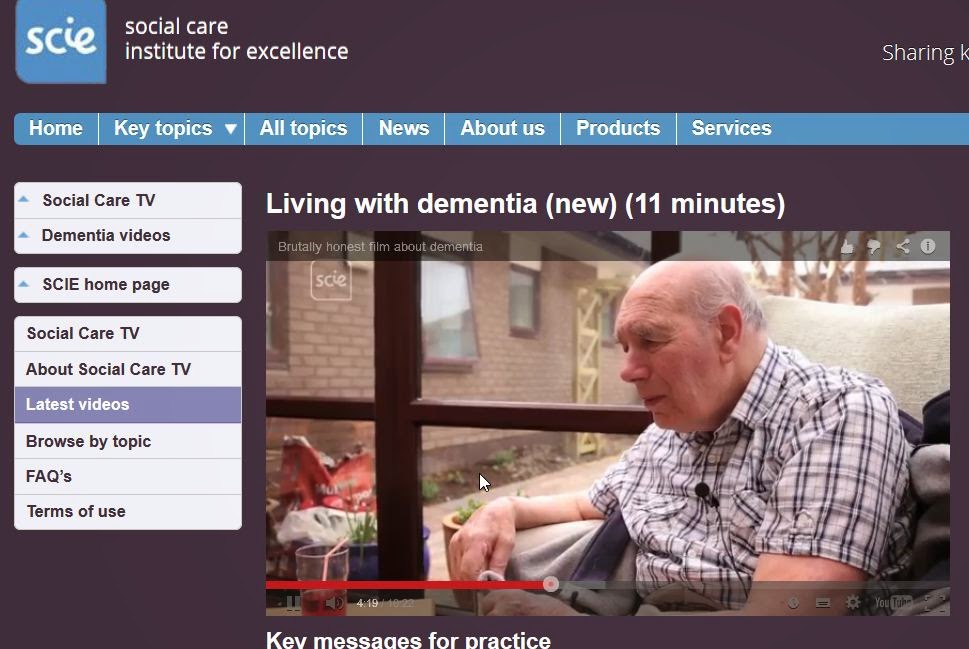
Link to the film
The commentary says: This brutally honest film reminds us that although dementia causes the loss of some abilities, people's feelings remain intact. The people in this film talk about their emotions: fear, guilt, embarrassment, isolation and powerless. They give a deeply moving and personal insight into an often overlooked aspect of the condition.
It also offers practice points:
1. People living with dementia can still be alert and aware of their condition
2. It is important to know the person with advancing dementia as an individual and support them to maintain their own identity
3. Although dementia causes the loss of some abilities, people's feelings remain intact; it is essential to empathise with people's emotions
4. Caring and supportive relationships help people to cope with the difficult experience of living with advancing dementia.
Monday, 3 March 2014
Why people with dementia should be involved in worship
 An interesting leaflet from MHA (the mainly Methodist organisation for housing and care for older people) and the CCOA (Christian Council on Aging) which I picked up while passing through a Methodist Home (this is what they call themselves; they seem to have dropped the word that the 'A' in the name originally stood for).
It is about worship and people with dementia, and is one of a number of leaflets about spirituality; the CCOA has a huge variety. The point is that although people with dementia may not have the same sophistication of appreciation of their Christianity that they once had, they can often appreciate the involvement in ritual that has been present for important parts of their lives. Worship for people with dementia, according to the leaflet, should be fairly brief, involving, use familiar materials and use well-known symbols, such as candles. Don't close your eyes when praying - it makes people feel cut off. the leaflet suggests suitable hymns and readings for particular themes.
Link to the leaflet on the MHA website (scroll down for downloads).
Monday, 20 January 2014
Dementia-friendly financial services are needed: a new Charter could help

I have often commented about the complexity of financial services for anyone, and particularly for older people, who have to rely on financial services rather than work for their income. Even more so for people with Alzheimer's disease or other forms of dementia which affect their capacity to cope even with honest banks and insurance companies, leave alone the devious and self-interested extractors of profit from vulnerable people. So a recently published 'dementia-friendly financial services charter', telling banks and the like what they should be doing to respond better to the needs of people with dementia is very welcome. the main aim is to train and encourage staff to be more aware and be able to help people with dementia, remembering that many will be out and about using services over several years in the early stages of the disease.
Of course, whether this will be any use depends on how financial services companies tka eit up, but local organisations could encourage their local ban branches to be aware of the charter and start training their staff. The actions to be taken are graded - and most are very easy, so there's no real excuse.
Tuesday, 7 January 2014
Involve carers in older people's care for the best outcomes
Older people with dementia are often living with frail husbands or wives; sometimes both have dementia. A Local Government Commissioner's Report (done with the Health Service Commissioner) on a case in Kirklees (in West Yorkshire, it covers the towns of Dewsbury and Huddersfield and smaller towns in between) shows how difficult it may be to deal with such situations, but how supporting the family's involvement is crucial.
In 2009 the husband (with dementia) was admitted to hospital with acute glaucoma, probably caused by a blow from his wife, whose dementia was also showing up. There seems to have been a safeguarding investigation, but it was never followed up, and the husband was shot out of hospital with no protection. This is not a big surprise to anyone familiar with health and social care: hospitals dealing with in-hospital decisions, especially if they need a bed for someone else, often know nothing about and therefore take no account of the home situation in their decision-making. If they employed or even liaised with social workers, they might know more about what's going on in their patients' lives.
The wife's symptoms worsened, and she was admitted to hospital: her husband went into respite care. Their son, a doctor, fixed up a private care arrangement for a nurse to provide home care, but the health trust and the local authority decided this was inadequate (without consulting him) and issued a Deprivation of Liberties order to authorise themselves to keep the husband in respite care without his consent. The health trust also took it upon themselves to write to the son telling him he should put them in separate homes, and sent a copy of the letter, presumably following the usual transparency guidelines, to the mother, causing her great distress.
The Local Government Commissioner said:
Link to the Local Government Commissioner's (Ombudsmen) Report.
In 2009 the husband (with dementia) was admitted to hospital with acute glaucoma, probably caused by a blow from his wife, whose dementia was also showing up. There seems to have been a safeguarding investigation, but it was never followed up, and the husband was shot out of hospital with no protection. This is not a big surprise to anyone familiar with health and social care: hospitals dealing with in-hospital decisions, especially if they need a bed for someone else, often know nothing about and therefore take no account of the home situation in their decision-making. If they employed or even liaised with social workers, they might know more about what's going on in their patients' lives.
The wife's symptoms worsened, and she was admitted to hospital: her husband went into respite care. Their son, a doctor, fixed up a private care arrangement for a nurse to provide home care, but the health trust and the local authority decided this was inadequate (without consulting him) and issued a Deprivation of Liberties order to authorise themselves to keep the husband in respite care without his consent. The health trust also took it upon themselves to write to the son telling him he should put them in separate homes, and sent a copy of the letter, presumably following the usual transparency guidelines, to the mother, causing her great distress.
The Local Government Commissioner said:
...the couple were denied the chance of living at home together in a settled lifestyle for longer than they did. The couple suffered a needless loss of dignity, while their son felt ignored, undermined and excluded from any decision about their care.and the Health Service Commissioner said:
Involving their son could have led to better outcomes for the couple. Families and carers can have the key to understanding the needs of their loved ones. That’s why public services must, in law, involve families and carers in making life changing decisions for vulnerable people.Utterly reasonable, and in addition to apologies, reviews of their practice and financial compensation, the trust and the local authority also agreed to review how they implemented their complaints policies, so presumably they told the family to buzz off when they complained, too.
Link to the Local Government Commissioner's (Ombudsmen) Report.
Monday, 1 July 2013
Moving to a care home with dementia

Link to the Demention blog post.
Wednesday, 15 May 2013
Inspiring story of living with dementia - Arnold Peters obituary

The Guardian today has an obituary of Arnold Peters, the actor who has been playing a character in The Archers, the long-running radio serial, which I've been listening to on and off since childhood. The character, Jack Woolley, has had dementia for some years. So, apparently did Peters, who recorded his part in his care home from 2008 to 2011, thanks to the BBC - good on them. An inspiring story about how you can live a good life with dementia, and also how, like the BBC, we should all be trying to help people live creative lives with dementia.
Link to the Guardian obit of Arnold Peters.
Tuesday, 8 January 2013
Life story work and care mapping for people with dementia: creative work is human, form-filling is not
I looked at the projects approved
for funding by the government’s dementia research programme. Most of the things
are about stepwise improvement in how various bits of the NHS manage dementia
care.
Link to the government's list of projects they are funding here. They are many (21) and various.
I picked out two that
interested me. One is about the use of life story work; this is a technique for
getting people to look at the different stages of their life and producing a written
account, or increasingly video and other kinds of product. I imagine that they
are interested in it because it might improve or use the memory of the person
whose dementia is worsening. But what I think is much more important about
these sorts of techniques is that way it encourages people to work on projects,
and be creative in what they are doing., So much health and social care focuses
on managing a care setting, and keeping people alive in what are fundamentally
boring environments. Creative activity is a really important way of combating
this.
The other thing I think is important
about this is that it is a form of activity which involves the person with
dementia taking part in human interaction with the person working on their
life story with them; so much conversation in care settings is humdrum
management stuff rather than personal, it also involves the person with
dementia leading the conversation with their life story, rather than answering questions
that are mainly of interest to the professional.
I also picked out the project
on something called dementia care mapping. The starting point for doing this
study is that people with dementia in care settings become agitated or
difficult in ways that the staff can’t cope with. As a result, such people with
dementia are more like to be admitted to hospital, and given anti-psychotic
drugs to cool them out, making them easier to manage. This is worrying in itself: years ago, social work developed a professional
policy that it was neither useful nor ethical to cool people out; better to
understand and work with their difficult behaviour. I wish other professions thought the same way.
But I would have wished that
they’d come up with something better to research than another ‘tool’. You may
be misled by the word ‘tool’ into thinking that this will be some concrete and practical
way of helping people in this position, but tools in the care world are usually
forms for staff to fill in. I’m always very interested in the interpersonal
content of the conversation when forms are being filled in, and then what is
done with them. Forms being filled in is often done in a routinised way by
staff who don’t really understand what they are about, and then don’t know how
to use them.
The project information says this is about staff development: but how are they going to
help staff develop using the material they are working with? The education process
that results is far more important than getting them to fill in the form. I’ll
wait for the research results before believing this is going to be widely useful. I
suspect it may turn out to seem wonderful to the people who are piloting it and
have research money spent on helping them to develop their understanding. For
the people who follow on after it is declared a success, I suspect it’s going
to be just another form to fill in.
These are the accounts of the projects in the Department of Health's list:
HS&DR 11/2000/11 Improving care for people with dementia: development and initial feasibility study for evaluation of Life Story work in dementia care.
People with dementia sometimes need help to communicate their histories and identities. This study will investigate how 'Life Story work' can help people living with dementia to do this, and whether this work can enable services to more effectively meet their needs. It will do this by speaking to people with dementia, their carers, and health care professionals about their experiences of Life Story work, and identifying areas of good practice.HTA 11/15/13 Evaluating the effectiveness and cost effectiveness of Dementia Care Mapping (DCM) to enable person-centred Care for people with dementia and their carers: A UK cluster randomised controlled trial in care homes (DCM EPIC trial).
At least two-thirds of people living in care homes have dementia and many become agitated or show other behaviours staff find challenging.
These behaviours are often linked to poor quality care and people with these behaviours are more likely to be admitted to hospital and are often prescribed antipsychotic drugs, which can cause harmful side effects. This study will involve 750 people with dementia and care staff in 50 care homes. 30 care homes will be randomly allocated to have staff trained to use Dementia Care Mapping; a practice development tool and process. The success of Dementia Care Mapping will be measured according to changes in behaviours staff find challenging, resident quality of life, the drugs residents are prescribed, the number of NHS services needed for residents, changes in the numbers and types of negative events residents experience (for example admission to hospital, falls), how staff feel about their job and staff resignations and sickness.
Thursday, 15 November 2012
Daily caring for somone with dementia
How someone cares for another important person in their life is a crucial part of experiences of ageing both for the carer and for anyone being cared for. Many of us do this in mid-life for the older generation and experience it later when it comes to our turn. Rob writes a blog and has also written an account of how he cares daily for his mother: but he is in his twenties and she is ion her fifties; she has Pick's disease, a fairly rare form of dementia that affects people in the middle of life.
Rob's account of caring is striking in its honesty and practicality. He says:

Link to Rob's account of daily caring.
 Other information on caring and finding care homes on the website of Care Homes UK
Link to Rob's blog, Demention
Rob's account of caring is striking in its honesty and practicality. He says:
I am committed to ensuring that the last few years of mum’s life are filled with as many happy moments as possible. This outlook on my responsibilities translates into completing activities with mum that focus on maintaining her independence, dignity, sense of involvement and enjoyment.A good set of principles for this heavy personal responsibility.

Link to Rob's account of daily caring.

Link to Rob's blog, Demention
Subscribe to:
Posts (Atom)